Self-regulation and metacognition
share a complex relationship:
both are useful in short term learning
and both can be considered long term education goals. Those of us who have
strong mechanisms for self-regulation and self-control learn more with less
effort, enjoy learning more and go onto live happier and productive lives
Student academic outcomes are also
positively influenced by the use of metacognitive strategies, while good
self-regulation is a strong predictor of academic achievement throughout
school, for instance preschool children who are good self-regulation are more
likely to be more proficient at Maths and reading. Therefore, both self-regulation
and metacognition must be viewed as a boon to learning content and not merely
an addition. In fact, there can be are “enormous” consequences for ours
students in both academic endeavours and in social relationships if they fail
to develop robust self-regulatory skills.
Thankfully, self-regulation is a
learnable skill, and as such requires practice and feedback as would learning
content knowledge. And so…
The
next section is about the role of metacognition in the acquisition of
declarative and procedural knowledge.
Right now, you are probably
thinking along one of three lines:
1.
Great, that sounds really interesting, or
2.
Great, that sounds awfully difficult: or
3.
Great, I already know something about that!
Instinctively, at the very
inception of learning our metacognitive monitoring process kicks in. In
retrospect, you will recognise all of these thoughts from your experience as a
learner, but recognising them and controlling and using them are different
matters. For instance, thinking that this section will be difficult could lead
to the decision to go off to make a nice cup of tea, and thereby avoiding the
effort you think is needed to read this. Alternately, it may be the spur to
concentrate, to make sure that you get it. Self-regulation and metacognitive
thinking are clearly wrapped up with motivation and its subsequent decision
making
Self-regulation.
Self-regulated learning is our
ability to understand and control our learning environment, and involves goal
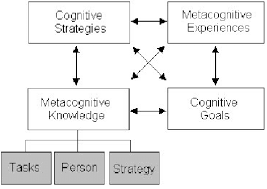
setting, selecting strategies and monitor our progress. The following diagram
neatly summarises self-regulation. (adapted from Schraw et al 1996)

The simplest, and perhaps most
potent definition of self-regulation is our “ability to inhibit automatic
responses” This requires control over our emotions, the ability to focus and
refocus our attention onto tasks and on our longer- term goals. When this is in
place we can then choose the right cognitive process that will help us best
complete the task.
Metacognition.
Metacognition is perhaps
the most intriguing part of self-regulation for teachers, as having well
developed metacognitive strategies are “the distinguishing quality between good
and poor learners” It is quite often given the prosaic thinking about our
thinking tagline, that undersells its value. Metacognition simply means “beyond
knowing”, inferring that it is about what we know, what we do not know, and the
thinking that monitors and controls the learning process. In a sense, it
involves us becoming the audience to our own performance. Flavell, the
originator of modern educational views of metacognition neatly summated it as
“a critical analysis of thought”, in which our knowledge about our own
cognitive processes and products (or indeed anything related to them), are seen
as something that can be used to regulate and orchestrate these processes.
Thus, leaving us with a noble definition for metacognition as the abilities of
individuals to adjust their cognitive activity in order to promote more
effective comprehension.