Welcome


My interest in the idea of sharing pedagogical purposes comes directly with the contact I have had with the Project for Enhancing Effective Learning at Monash University in Australia. Now each of these teachers were very active in establishing learning agendas with their classes. The impact they were having was inspiring. Each classroom tool can have a purpose beyond delivering content, and this needs to be shared.
I suppose the purpose of this website is collate, crystalise and open dialogues about how to increase this within classrooms. As the quote from Carl Bereiter illustrates this classroom methodology can empower our students.

Showing posts with label self regulation. Show all posts

Thursday, 7 June 2018

Defining self-regulation and metacognition.


Self-regulation and metacognition share a complex relationship:  both are useful in short term learning and both can be considered long term education goals. Those of us who have strong mechanisms for self-regulation and self-control learn more with less effort, enjoy learning more and go onto live happier and productive lives 
Student academic outcomes are also positively influenced by the use of metacognitive strategies, while good self-regulation is a strong predictor of academic achievement throughout school, for instance preschool children who are good self-regulation are more likely to be more proficient at Maths and reading. Therefore, both self-regulation and metacognition must be viewed as a boon to learning content and not merely an addition. In fact, there can be are “enormous” consequences for ours students in both academic endeavours and in social relationships if they fail to develop robust self-regulatory skills.
Thankfully, self-regulation is a learnable skill, and as such requires practice and feedback as would learning content knowledge. And so…
The next section is about the role of metacognition in the acquisition of declarative and procedural knowledge.
Right now, you are probably thinking along one of three lines:
1.       Great, that sounds really interesting, or
2.       Great, that sounds awfully difficult: or
3.       Great, I already know something about that!
Instinctively, at the very inception of learning our metacognitive monitoring process kicks in. In retrospect, you will recognise all of these thoughts from your experience as a learner, but recognising them and controlling and using them are different matters. For instance, thinking that this section will be difficult could lead to the decision to go off to make a nice cup of tea, and thereby avoiding the effort you think is needed to read this. Alternately, it may be the spur to concentrate, to make sure that you get it. Self-regulation and metacognitive thinking are clearly wrapped up with motivation and its subsequent decision making
Self-regulation.
Self-regulated learning is our ability to understand and control our learning environment, and involves goal setting, selecting strategies and monitor our progress. The following diagram neatly summarises self-regulation. (adapted from Schraw et al 1996)
The simplest, and perhaps most potent definition of self-regulation is our “ability to inhibit automatic responses” This requires control over our emotions, the ability to focus and refocus our attention onto tasks and on our longer- term goals. When this is in place we can then choose the right cognitive process that will help us best complete the task. 
Metacognition.
Metacognition is perhaps the most intriguing part of self-regulation for teachers, as having well developed metacognitive strategies are “the distinguishing quality between good and poor learners” It is quite often given the prosaic thinking about our thinking tagline, that undersells its value. Metacognition simply means “beyond knowing”, inferring that it is about what we know, what we do not know, and the thinking that monitors and controls the learning process. In a sense, it involves us becoming the audience to our own performance. Flavell, the originator of modern educational views of metacognition neatly summated it as “a critical analysis of thought”, in which our knowledge about our own cognitive processes and products (or indeed anything related to them), are seen as something that can be used to regulate and orchestrate these processes. Thus, leaving us with a noble definition for metacognition as the abilities of individuals to adjust their cognitive activity in order to promote more effective comprehension.
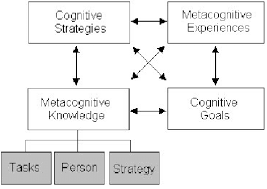
Flavell’s model of metacognition helps to define what is useful in practical classroom terms. In Flavell’s model both cognitive and metacognitive processes interact to form our metacognitive knowledge about ourselves, the task at hand and potential useful strategies. The cognitive goals set the context for the thinking to be undertaken and are also the end point. 


Wednesday, 18 December 2013

A little conversation.

Context: Year 8 Science students have been invetsigating the truth of the 5 Second rule.  Writing hypothesis, carrying out fair tests, using aseptic technique, analysing the data and drawing conclusions based upon the evidence.

Purpose: The aim of this sequence of practical lessons has been to develop the students notions of the independent and dependent variables. A very useful abstract concept, but will serve to transfer the science skills being learned.

Start Point: The students have completed four lessons and two homeworks in this lesson sequence. I have marked their work focussing on the "Controlled Variables" , the "Graph" and the "Conclusion" (that has been structured around a P.E.E paragraph structure. The students have just spent 45 minutes or so responding to my feedback, which is focused around the use of the Independent and Dependent. variables, they are in the throws of completing this task.They are reaching the point where, they are tiring and its that moment wher you notice they beging to beome off task, and classroom noise becomes audible and different.

Confronted with this situation I had six simple choices

1. Be Ineffective. Ignore it.Whinge and call it a crisis.
2. Be Busy. Circulate to re-engage those of task
3. Be Negative. Say its too noisy in here, be quiet and get on with your work.
4. Be Positive. Prsise the efforts of the students so far, encourage them.
5. Be Crafty. Change the task that the students.
6. Be Purposeful. Develop Self regulation.

I plummed for the Self Regulation, as Children are more focused and self-controlled when teachers listen to them and emphasize the positive rather than the negative. I've kind of wrote about this before here.   Here is how I decided to deal with it.

The conversation:

"What might I be concerned about, right now?"
"We are noisier"
"Mmmm, OK, What else?"
"The work rate is a bit slower?"
"And?"
"We are getting more distracted?"
"What else?"
"That we are understanding how to use the Independent and Dependent varibales?" ( I don't know why, but I'm still a little taken a back when my students know what they are doing!)
"Exactly, I can see you have worked hard practicisng , 'cos that's what we are doing here! Let's remember why we are doing this, and that it is a difficult skill to master.You have all put a big effort into getting this right . Can you identify the Indpendent and dependent varaibles? Can you say how the Independent varaible affects the dependent?" 

The Crux: A series of questions we then asked"What can we now do as a result of our effort? How do we make the most of the effort you already made? What happens now to make sure you complete this task to standard you are happy with?  "

The students went on ask for more time to complete this task, and refocused on quality within  the task. " I need to rephrase conclusion to put the independent variale before the depednedent" "I've made the scale too small on my graph." A seemingly generic intervention led to subject specific reflection.Remarkably, this conversation has happened in two different teaching groups, almost word for word. Would this have happened with options one to five?

My view: I had noticed that after 40 odd minutes of hard slog, the students were tired, and a few were infact doing the things they identified as negative. The initial reason I stopped the class was to manage their learning behaviour, I wanted to prolonge this sustained effort. "Telling them off" for being off task may have been counter productive.

By framing my repsonse in terms of what was being learned ( if it had not emerged I would have told them, and then asked why?) I want the students to connect learning with sustained effort, it was important to catch the students working hard, even if some had went just beyond this and were in search of a much needed break. Secondly, as with all teaching activities, students become distracted by the task at hand, it is easy for students to forget the reasons the work is important duirng an activity. "I'm doing me work Sir" as opposed to "I am learning how/ about/ why ", it is why the children behaves, teacher tells model has failed us. Despite the obviously charm of such as simplistic model, it simply does not work. Students must be engaged in the process, if we can do this students choose to do the hard option, in this case to continue and improve their understanding.

So, even behaviourial responses can be educative, in this case both Content and Process driven. It is worthwhile considering what the other three options would have brought about. In this instance I did use praise, but only after we had identified the (potential) problem. Being busy and being negative would have worked me, but not necessarily the students nor impacted upon the quality of the student work or learning. Being crafty would have avoided the  challenge and distract from what I wanted them to learn.


Learning does not happen in 20 minutes, it requires sustained, clever, engaged effort, and sometimes students can provide these conditions for themselves.