

Showing posts with label critique. Show all posts
Showing posts with label critique. Show all posts
Wednesday, 28 January 2015


Friday, 4 October 2013
Wednesday, 17 April 2013
What are critiques for?
Besides improving the quality of student work,being an opportunity to check (real) progress, reflect upon next steps, and being an opportunity to teach critical ideas to an audience of engaged students. What is the point of these time consuming assessment tasks?
For me, and for academic success, it's cultural. It's part of how classroom should be to help learning take place.
It's easy to empathise with the novice student who is about to "volunteer" their work for a whole class critique. To them it is a risk to be taken, nominally through the fear of being judged, but also by being aware of the haphazard nature of "peer assessment". The "add more detail" comments adding confusion, instead of clarity only decreasing the merit in taking the risk. However, it must be remembered that if a piece of work is worthy of critique, it will (or should) display the complexity of that students learning. We need to revel in this.
The classroom community is the grease that makes critiques work. This is why we have the protocols, to help manage the risk. Although simply written, these contain several cultural devices which are important in ensuring critiques work for the classroom community.
The first of these is in beginning the critique by seeking "kind, positive or warm feedback" , obviously important for making people feel that their work is appreciated. Although the big reason for this goes way beyond this simple aim. It's more about looking at the work in an open minded way, finding what works, as well as what has not. Both the strengths and the weaknesses are useful. It is at this point that the critique becomes more about every students work, than it does about the individual work being scrutinised. By highlighting the strengths, students learn what quality work is like, and by teachers endorsing and interpreting these views we provide models of quality that students can then emulate.
This focus also, evinces the value of working with others, showing the dialetic nature of learning. Individuals benefit from the input from their community, but also the individuals can be benefit to their community.
This is why, as teachers we need to teach the procedural knowledge involved in taking part in a critique and offering feedback. We do this by modelling it in our own feedback, being metacognitive during critiques and providing feedback on the feedback being given. It teaches how to speak in a learning community:with respect, tolerance. compassion and focus on high academic standards.
Both students and teachers too often make judgements of others on a superficial basis. How much do we really know about each others strengths and expertise? Do we value these and make it part of our culture? Sometimes, as teachers we do need to prioritise our classroom community before we can address the academic and skills needs of our students. This is a start point.
The final aspect is more permeating. Critiques should lead to the process of critique becoming less formal. By this I mean it becomes part of how the community speaks to one another and these conversations becomes ubiquitous. Where students not only offer feedback to peers but actively seek it. They view each others work and offer praise and then suggest ways to improve it without prompt or scaffold. It's how we are as people. This is the ultimate aim of critiques.
For me, and for academic success, it's cultural. It's part of how classroom should be to help learning take place.
It's easy to empathise with the novice student who is about to "volunteer" their work for a whole class critique. To them it is a risk to be taken, nominally through the fear of being judged, but also by being aware of the haphazard nature of "peer assessment". The "add more detail" comments adding confusion, instead of clarity only decreasing the merit in taking the risk. However, it must be remembered that if a piece of work is worthy of critique, it will (or should) display the complexity of that students learning. We need to revel in this.
The classroom community is the grease that makes critiques work. This is why we have the protocols, to help manage the risk. Although simply written, these contain several cultural devices which are important in ensuring critiques work for the classroom community.
The first of these is in beginning the critique by seeking "kind, positive or warm feedback" , obviously important for making people feel that their work is appreciated. Although the big reason for this goes way beyond this simple aim. It's more about looking at the work in an open minded way, finding what works, as well as what has not. Both the strengths and the weaknesses are useful. It is at this point that the critique becomes more about every students work, than it does about the individual work being scrutinised. By highlighting the strengths, students learn what quality work is like, and by teachers endorsing and interpreting these views we provide models of quality that students can then emulate.
This focus also, evinces the value of working with others, showing the dialetic nature of learning. Individuals benefit from the input from their community, but also the individuals can be benefit to their community.
This is why, as teachers we need to teach the procedural knowledge involved in taking part in a critique and offering feedback. We do this by modelling it in our own feedback, being metacognitive during critiques and providing feedback on the feedback being given. It teaches how to speak in a learning community:with respect, tolerance. compassion and focus on high academic standards.
Both students and teachers too often make judgements of others on a superficial basis. How much do we really know about each others strengths and expertise? Do we value these and make it part of our culture? Sometimes, as teachers we do need to prioritise our classroom community before we can address the academic and skills needs of our students. This is a start point.
The final aspect is more permeating. Critiques should lead to the process of critique becoming less formal. By this I mean it becomes part of how the community speaks to one another and these conversations becomes ubiquitous. Where students not only offer feedback to peers but actively seek it. They view each others work and offer praise and then suggest ways to improve it without prompt or scaffold. It's how we are as people. This is the ultimate aim of critiques.
Friday, 1 February 2013
Three Students explain the drafting of their work.
These brief clips speak for themselves. Sophisticated, hard working and talent young people.
Wednesday, 21 November 2012
Lieracy and Science part 2- Writing strategies.
This is the second part of a blog post on why and how developing literacy in Science is beneficial to teach and learning science.
Unsurprisingly my educational appreciation of Connectives derives from my use of SOLO taxonomy. In a Science context, it also makes sense to classify them as in these useful resources. This helps to chunk content knowledge with the appropriate connectives. For example while sequencing the route of blood through the heart, or a method. Sequencing is essential for lots of science concepts. Add to this the Cause and Effect connectives, such as because, therefore and due to and your students will have a decent start point for Scientific thinking armoury. This is the exact reason why being explicit with these is a great case in point for teaching literacy as it also develop Scientific thinking.
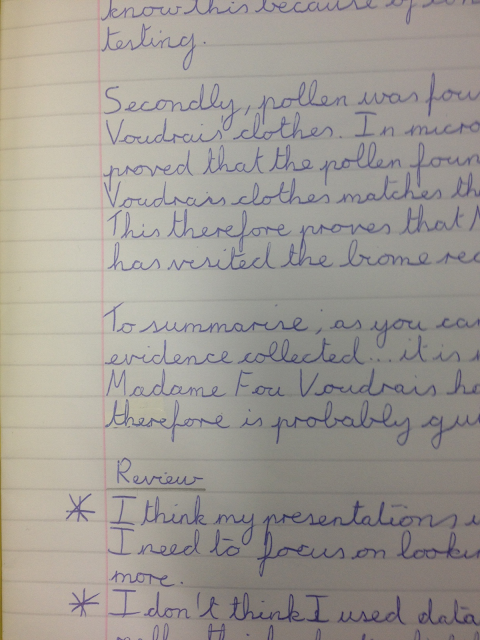
This photograph shows how useful they are to students. During a critique these Year 7 students (correctly) identified that the final paragraph needed restructuring to bring together all of the evidence. So I asked what connectives might be useful, the three they chose were most helpful as can be seen by the next two pictures of student draft two's!


A post on connectives structured around SOLO can be read here.
That Superman amongst us David Didau embellishes upon this here
One of the main focuses I have recently had is how students write. This has been especially during writing methods (instructions) and conclusions. I have encouraged, through critique and feedback for my students to write in the third person. This has many benefits for learning Science. Firstly it encourages students to write more clearly about the Science, data, findings etc and not hide behind what they think or even what they did. The more I have thought about this the more I have come to realise that it encourages that wonderful Scientific trait of objectivity. That is to say, for the sake of an example.... By writing in the third person students are trained to become more objective in their thinking. (See it works!)
This students work show the impact it has on the quality of the Scientific work. Surprisingly, this work only took twenty minutes, yet the progression is still taking place and started weeks ago. Learning eh! (Irony)

The Point Evidence Explain (P.E.E) paragraph has also become a regular feature as students learn to write conclusions to experiments or investigations. Although, this seems a straight forward method it is worth considering an "analysis" section or activity before students write. You'd think the need to have processed the data before you started writing would be a no brainer. Apparently it's not. As a result I have formalised the analysis before requesting a P.E.E. paragraph for the conclusion. Don't let this put you off, the familiarity of P.E.E. to students does help make the abstract task of drawing conclusions at least a more structured affair.

Both connectives and the PEE paragraph allows the teacher to hoop jump, meeting the need for teachers to mark for literacy, but in a really useful way for both the subject knowledge and literacy. Now that's subversive. I think the following examples show this and the impact of the marking, which even occurs between activities. Learning eh! (Irony)


The role of projects, success criteria and critique in my development as a teacher has been central to my growing understanding of literacy and it's importance. Asking students to complete worthwhile tasks, that has an audience makes the use and emphasis upon literacy purposeful. This adds an essential ingredient, namely motivation. When you add this to the clear demonstration of progress (let reclaim that word) students see value in literacy. This is the power of teaching it in ALL curriculum areas, it becomes normal. I am yet to have a student complain or whine at the prospect of practising their literacy, young people see it's a vital part of learning and being successful. So no matter how uncomfortable I feel using them, it has clarified how I look at my subject and how I teach it.
 Using models whether teacher or student derived to draw out success criteria demonstrates this wonderfully. Increasingly students are suggesting these literacy qualities as part of their success. This is real progress for me.
Unsurprisingly my educational appreciation of Connectives derives from my use of SOLO taxonomy. In a Science context, it also makes sense to classify them as in these useful resources. This helps to chunk content knowledge with the appropriate connectives. For example while sequencing the route of blood through the heart, or a method. Sequencing is essential for lots of science concepts. Add to this the Cause and Effect connectives, such as because, therefore and due to and your students will have a decent start point for Scientific thinking armoury. This is the exact reason why being explicit with these is a great case in point for teaching literacy as it also develop Scientific thinking.
This photograph shows how useful they are to students. During a critique these Year 7 students (correctly) identified that the final paragraph needed restructuring to bring together all of the evidence. So I asked what connectives might be useful, the three they chose were most helpful as can be seen by the next two pictures of student draft two's!


A post on connectives structured around SOLO can be read here.
That Superman amongst us David Didau embellishes upon this here
One of the main focuses I have recently had is how students write. This has been especially during writing methods (instructions) and conclusions. I have encouraged, through critique and feedback for my students to write in the third person. This has many benefits for learning Science. Firstly it encourages students to write more clearly about the Science, data, findings etc and not hide behind what they think or even what they did. The more I have thought about this the more I have come to realise that it encourages that wonderful Scientific trait of objectivity. That is to say, for the sake of an example.... By writing in the third person students are trained to become more objective in their thinking. (See it works!)
This students work show the impact it has on the quality of the Scientific work. Surprisingly, this work only took twenty minutes, yet the progression is still taking place and started weeks ago. Learning eh! (Irony)

The Point Evidence Explain (P.E.E) paragraph has also become a regular feature as students learn to write conclusions to experiments or investigations. Although, this seems a straight forward method it is worth considering an "analysis" section or activity before students write. You'd think the need to have processed the data before you started writing would be a no brainer. Apparently it's not. As a result I have formalised the analysis before requesting a P.E.E. paragraph for the conclusion. Don't let this put you off, the familiarity of P.E.E. to students does help make the abstract task of drawing conclusions at least a more structured affair.

Both connectives and the PEE paragraph allows the teacher to hoop jump, meeting the need for teachers to mark for literacy, but in a really useful way for both the subject knowledge and literacy. Now that's subversive. I think the following examples show this and the impact of the marking, which even occurs between activities. Learning eh! (Irony)


and its follow up task ...

The role of projects, success criteria and critique in my development as a teacher has been central to my growing understanding of literacy and it's importance. Asking students to complete worthwhile tasks, that has an audience makes the use and emphasis upon literacy purposeful. This adds an essential ingredient, namely motivation. When you add this to the clear demonstration of progress (let reclaim that word) students see value in literacy. This is the power of teaching it in ALL curriculum areas, it becomes normal. I am yet to have a student complain or whine at the prospect of practising their literacy, young people see it's a vital part of learning and being successful. So no matter how uncomfortable I feel using them, it has clarified how I look at my subject and how I teach it.

Thursday, 27 September 2012
By Josie and Emily.
I asked two students if they coudl summarise what they thought of Critiquing. Here are their thoughts undiluted and without alteration.
The Importance of critiquing-
We
think critiquing is good and important because it helps to...
Complete all of the criteria and check the other person has too. This is important as to achieve the full potential of a write up,drawing,etc. You need to ensure that all of the points or features are focused on, in detail. For example,check if people include both sides of an argument? Or in a drawing scenario, have the minor details still been focused in on?
Reading other people's work and using it as inspiration for your own. Not necessarily copying,but enhancing your own work. For example,if the other person has included a particularly effective phrase,or point about the argument,include it in yours to improve it! This helps you to share thoughts about what should be included, and generally improve your work!
Information around you,you can collect more information through other people's work,e.g the community scroll of information as a reliable source that you can trust. A source of information like the scroll is really useful. For example, if you don't have time to research but want to quickly find out about,say,solar energy, look at the community scroll (class display) for a variety of important diagrams,facts and figures. This helps to condense information,and use the big facts, to save time and share facts.
Talk and discussing ideas,rather than sitting alone writing an essay,makes learning more enjoyable,therefore putting in a motive to get the piece of work complete. It makes it good to compare different opinions and thoughts. For example, if you do task A and write an essay about it,and your partner does task B and writes an essay about it,while critiquing their work,you can learn about the actual task B and they learn about task A,taking in twice as much information.
Improve your work in general. If you critique a few times,and compare the first and second,there is a drastic difference. It's almost like putting your work through a focus group test,seeing if one person understands and learns from it,before publishing it for the teacher to read/mark. This makes you achieve your best ability,as although your partner points out improvements,you still do the work and make it make sense.
Complete all of the criteria and check the other person has too. This is important as to achieve the full potential of a write up,drawing,etc. You need to ensure that all of the points or features are focused on, in detail. For example,check if people include both sides of an argument? Or in a drawing scenario, have the minor details still been focused in on?
Reading other people's work and using it as inspiration for your own. Not necessarily copying,but enhancing your own work. For example,if the other person has included a particularly effective phrase,or point about the argument,include it in yours to improve it! This helps you to share thoughts about what should be included, and generally improve your work!
Information around you,you can collect more information through other people's work,e.g the community scroll of information as a reliable source that you can trust. A source of information like the scroll is really useful. For example, if you don't have time to research but want to quickly find out about,say,solar energy, look at the community scroll (class display) for a variety of important diagrams,facts and figures. This helps to condense information,and use the big facts, to save time and share facts.
Talk and discussing ideas,rather than sitting alone writing an essay,makes learning more enjoyable,therefore putting in a motive to get the piece of work complete. It makes it good to compare different opinions and thoughts. For example, if you do task A and write an essay about it,and your partner does task B and writes an essay about it,while critiquing their work,you can learn about the actual task B and they learn about task A,taking in twice as much information.
Improve your work in general. If you critique a few times,and compare the first and second,there is a drastic difference. It's almost like putting your work through a focus group test,seeing if one person understands and learns from it,before publishing it for the teacher to read/mark. This makes you achieve your best ability,as although your partner points out improvements,you still do the work and make it make sense.
Question your work and improve it,through another's eyes. In a real life example,Josie thought her write up about fossil fuels was the best to her ability, however,when Emily pointed out improvements from a first-eye source,it made Josie realise how much more she could've done in the first place. Therefore,if we get used to critiquing others work,when we are older and in a job,we can almost critique our own work,independently.
Understand the importance of teamwork,and collaboration, community thinking and sharing ideas. This helps build teamwork,valuing critiquing people's work as important as completing your own.
Ideas shared to get a balanced view,rather than simply one opinion,to come to a more balanced conclusion. For example, if you already,before beginning to learn about a topic, have strong views on it,it may be hard to write a evenly balanced and unbiased essay,however if you read somebody else's essay it may open your eyes to a new arguement.
Not just a teacher's opinion,more varied opinions to improve your work for all audiences. The teacher is working off a grid from the curriculum,the peer is working from their own sense and probably no knowledge on the subject,therefore making a good audience.
Guide you to get a peer's opinion on your work. There are always improvements to be found,in learning and life, nothing is perfect,so there are always ways you can critique work KIND (critique the WORK,not the people, don't use "you" or "shouldn't,couldn't,wouldn't, say what they CAN do instead of what they CAN'T), SPECIFIC(say exactly where,highlighting or colour coding makes it easier to point out places) and HELPFUL(make them easy to improve,for example,don't say "your spelling was bad" or even "the spelling in this piece of work could be improved". It is more helpful to say "There could be improvements in spelling these words; atmosphere, solar and fossil")
Overall,we believe,as students,critiquing is an important lesson in learning,and in general life. It is a useful skill to incorporate in lessons, in order to prepare future "self critiquing" as well
Subscribe to:
Posts (Atom)