Welcome


My interest in the idea of sharing pedagogical purposes comes directly with the contact I have had with the Project for Enhancing Effective Learning at Monash University in Australia. Now each of these teachers were very active in establishing learning agendas with their classes. The impact they were having was inspiring. Each classroom tool can have a purpose beyond delivering content, and this needs to be shared.
I suppose the purpose of this website is collate, crystalise and open dialogues about how to increase this within classrooms. As the quote from Carl Bereiter illustrates this classroom methodology can empower our students.

Showing posts with label pedagogical content knowledge. Show all posts

Thursday, 14 May 2020

Using Genre Pedagogy to develop student writing.


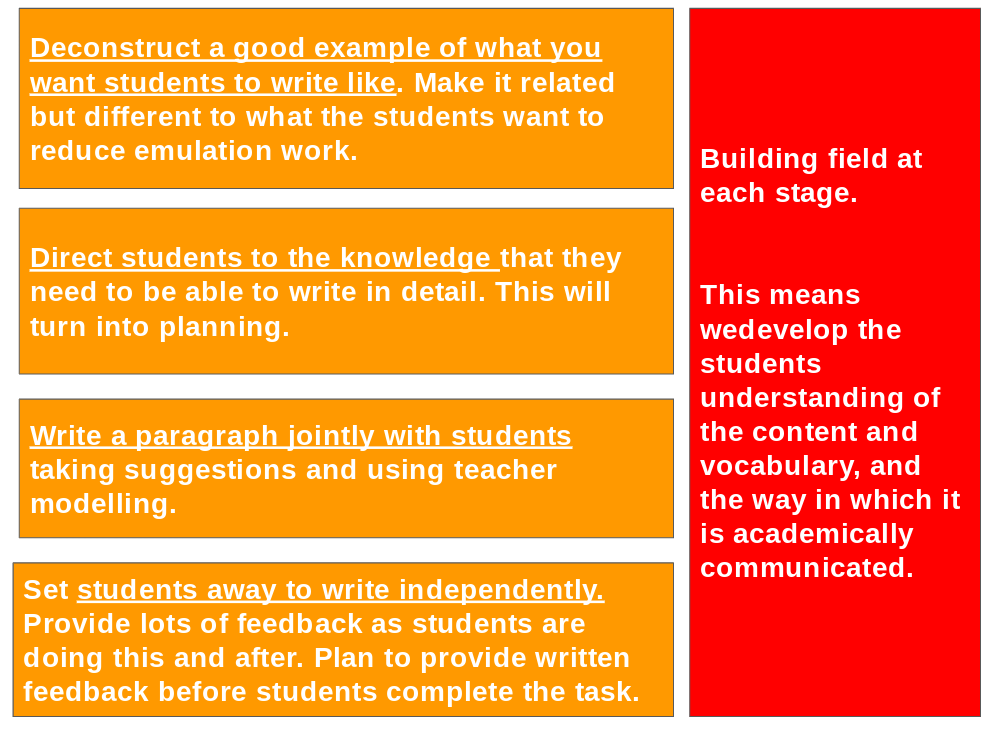
A common and very useful technique used in the teaching of teaching these features of scientific writing is the genre pedagogy cycle. This is a strategy that is applicable acriss the curriculum; here I present how I use it as science teacher and here is how a History teacher uses it in there subject (Kudos- this is where I first encounterred it on Lee Donaghy's superb and illustrative blog posts ) I have simplified this below.
This image has an empty alt attribute; its file name is screenshot-2020-04-09-at-11.37.31-am.png
The skill of essay writing is complex and so naturally fits into something that can be broken down into smaller parts. The first step of the genre pedagogy cycle is to deconstruct an exemplar piece of text that is ideally closely related to the topic the students will practise with independently. This prevents them from merely copying the teacher and is an opportunity to revisit prior knowledge. This is followed by a joint construction stage in which the teacher who, through questioning, involves the students in the co-construction of a text. This will inevitably will be a collection of student ideas which the teacher improves and talks through in the process of recording those ideas. It is vital that the teacher shares their internal monologue while doing this, saying what they think and why certain sentence structures work and so on. Next, the students are sent away to practise writing independently. The students will require large amounts of feedback during and after the writing process, along with multiple opportunities to write academically to fully develop this essential skill.

An example dissected.

In preparation for writing an essay on ‘Where does new human life come from?’ in which they are asked to use connectives to sequence the action (e.g. next, firstly, following that, this leads to, then), the students, with guidance and teaching, break down a couple of paragraphs on external fertilisation in amphibians:
"External fertilisation is a form of reproduction when the female’s ovum is fertilised by the male’s sperm outside of the female body. Since sperm need to swim and the developing egg must be moist, external fertilisation always occurs in water. Elaborate courtship rituals are sometimes used to ensure that the sperm and the eggs are released close enough together to ensure fertilisation. It is therefore unsurprising that fish and amphibians are the organisms that use this method to create new life. "
"External fertilisation has many advantages, especially for the parents. After fertilisation, many species of fish and amphibians do not expend effort in looking after the young. This allows them to feed and breed again so that they produce large numbers of offspring to increase the chance of some surviving to adulthood."
The purpose of this is to identify the strategies, styles and rules that must be focused on while writing. As a rule, I always start by recording student observations and comments before moving on to any aspect of teaching, which allows me to start where the students are at. I then begin to model that this is a collaborative process which, in turn, sets up one the main requirements for deliberate practice to take place – namely, that the students need to understand the task so they have some element of control. I find that this helps to invest the students in the conscious and focused effort needed for success. If the students do miss something, then the example (if it is well planned) should show them how to write scientifically. A list of the characteristics evident in the example might include:
  • Written in the third person.
  • Each paragraph starts with a topic sentence that says what something is and what it does.
  • Each topic sentence includes a topic noun early in the sentence. 
  • Written in the past or present tense.
  • Is specific in describing where and when something occurs.
  • Sequences the processes using time connectives.
Only after the students have this understanding will I present the task they are to complete. This will highlight the content to be included and the writing skills I expect to see – in this case:
Extended writing task: Where does new human life come from?
Your task is to write a report about how the male and female reproductive systems develop and how they work in the conception and development of new life. 
Content criteria
The report must include the following information:
  • The organs involved correctly spelled and their role described.
  • Describe the process of puberty for your gender and the opposite one.
  • Explain how fertilisation and implantation is more likely on certain days of the menstrual cycle.
  • Name the sex cells and explain how they come together.
  • Describe each stage of how a fertilised egg grows into a baby during pregnancy.
  • Explain how the placenta and the mother’s blood supply provide the oxygen and the nutrients needed for the baby to grow.
Report criteria
Writing to inform
To inform means to give facts to another person.
When writing to inform/report, make sure:
  • Language is clear, factual and impersonal.
  • Use short and clear sentences.
  • Break up the writing with diagrams, illustrations, pictures and subheadings.
  • Topic nouns organise the text.
Writing to explain 
To explain means to make clear, show the meaning or to account for – you are trying to say how or why something happens. 
  • Writing to explain is generally in the third person and in the past or present tense.
  • Use clear and factual language.
  • Use sentences that link a cause and an effect.
  • Use connectives to compare (e.g. whereas, though, while, unless, equally, however).
The next phase of the genre pedagogy cycle is to jointly construct some writing with the students. Once more, the control of this activity is seemingly with the students, but it remains an opportunity for me to model, when necessary, how I would go about completing the task. I start by giving the students a minute or two to come up with a potential topic sentence. I then either take multiple examples and write them up on the whiteboard (or type them up) or take one and seek to improve it. 
The process may take student writing through the following developments:
Skill being practisedCo-constructed sentences
StartThe organs are the ovaries, uterus and testes. 
Addition of detailThe main organs are the ovaries, uterus and testes.
Locating when this is occurringThe main organs involved in reproduction are the ovaries, uterus and testes.
Adding detail – linking back to the topic sentenceThe main organs involved in reproduction are the ovaries, uterus and testes. The ovary releases the egg.
Locating the actionThe main organs involved in reproduction are the ovaries, uterus and testes. The ovaries are where releases the egg.
Checking and correcting grammarThe main organs involved in reproduction are the ovaries, uterus and testes. The ovaries are where the egg is released.
Adding detailThe main organs involved in reproduction are the ovaries, uterus and testes. The ovaries are the place where the egg is developed and released.
Applying sentence structure and going back over to add further (locating) detailThe main organs involved in reproduction are the ovaries, uterus and testes. The female’s ovaries are the place where the egg is developed and released. The male’s testes is the place where the sperm are developed and released. 
Final – interestingly worked backwards to add more detail and connectives to emphasise detailThe main organs involved in reproduction are the ovaries, uterus and testes. The major female organs are the ovaries and uterus. The ovaries develop and release the egg, whereas the uterus grows and develops the embryo. The male testes develop and release sperm cells.

The process continues, building up each sentence and paragraph until it is complete or it is clear that the students are ready to practise independently. This is clearly a slow and time consuming task. This particular task (which is for Year 7s) takes about 45–60 minutes before they get to practise independently. However, the conditions for deliberate practice have now been established and the students are therefore more likely to set about practising and writing to a high(er) standard.
The process of practice is hard work. During this phase, it is important to focus on whether the students are aware of what it is they are being asked to do rather than on the quality of what is being written. Having the success criteria and examples available makes this a much more tangible thing for the students to understand and therefore deliberately practise.

Opportunities to demonstrate learning

There are two purposes in planning this kind of learning activity. Firstly, it acts as another exposure to the information but it also serves to transfer the knowledge to subtly new situations, taking the student from novice to expert. Secondly, the type of feedback required for this type of activity will be more academic or content based, as opposed to the procedural or ‘how to’ feedback that practice requires.
Even simple strategies such as completing an exam question can achieve this, providing the students have the chance to rehearse the ideas, elaborate on them, recall them and then reflect on them with constructive feedback. The feedback a teacher provides should be a combination of content based comments and guidance on how to do something. This includes how the knowledge is organised.

Wednesday, 4 March 2020

What can teachers do to tackle student misconceptions? An example.

Posner and Strike (1992) suggest that the following conditions must be met if students are to correct their misconceptions (or to have them corrected):
  • There must be some dissatisfaction with the student’s current understanding. Students are unlikely to be aware of these, and it therefore falls to us to make them purposefully aware of the ones they hold. This can be difficult, as theories” work for them perfectly well in their everyday lives, and we have to tutor students to become critical of their own thinking.
  • The new conception must be intelligible or understandable to learners. This is where our skill in representing ideas specifically tailored to the learning needs of the students in front of us comes to the fore. Our assessment practices need to allow the students (and teachers) to see that they are ‘getting it’.
  • The new conception must appear initially plausible; it must seem to be a better possible answer than the misconception. 
  • Keeping our instruction ‘real’, rooted in what is known (i.e. their prior knowledge), making connections clear and using concrete examples all help students to alter their understanding of things.
  • Finally, the new conception should suggest the possibility being fruitful or useful to them as learners. We can do this by helping students transfer their new understanding and applying it to new examples.
I would humbly add that the role of planned multiple exposures to the correct conception is also essential. Undermining hard held believes is going to take time to shift. 

Strategy 1: Encouaging dissatisfaction.

These tasks are designed to make students ware of the misconception, in a way the makes it absolutely clear that the student did not know that they did not know. For this to happen the alternate answers must at least seem plausible and contain the same kind of content as the correct answer.

The following example, fails to do this with only one plausible answer as John Fashanu, Noel Edmonds and Skeletor did not ride the Tour de France until the 1980's. That was a joke by the way, I point out this not as way of being facetious but as a way of emphasising that it is quite easy to accidently teach a misconception. 

For more on the design of multiple choice question I highly recommend this from Vanderbilt University
In this science example, students often think that the current comes from the battery, jumping out when the circuit is connected. In addition this misconception is linked to another where student believe the current is "used up".  So this dealing with this first will allow this idea to be transferred and applied to this situation. It is therefore going to be fruitful, and be part of a sequence of multiple exposures to the correct concept.

Note that only three options are given in this question , but importantly all answers are plausible.  So rather than sticking to a steadfast rule of  say "I will always give 5 options", the plausibility of the content takes precedence. 
When deliberately trying to exposure a misconception, I tend to do so with a whole class discussion. Using techniques that involves as many students as possible, for instance: asking for hands up fro each response, before asking a few students why they think what they do. Interestingly this year I had one student, almost instantly,  asking " is this about a metals delocalised electrons?" He knew the answer but was not confident about, so exposing it and reinforcing the correct answer can help those with and without significant prior knowledge on the content. If he had of been confident my tactic would have been to  defer my answer in an attempt to create a bit of ambiguity, to encourage dissatisfaction, and further thought. Normally stuidents think ( and they did even when this student spoke up) that the current comes from the battery. I try to avoid telling them that they are wrong, as I wan them to doubt it themselves first. So ambigous responses such as "mmm interetsing" help do this. 

Although, I may use a similar or even the same question in a Pre Quiz to a module, when attempting to incite some dissatisfaction with the student’s current understanding it is important that we focus on one concept at a time whenever possible. Clearly some misconceptions will have complex and interconnected reasosn so this is is not always possible. 

Strategy 2: A plausible and intelligible alternative

The next slide has my follow up to this discussion, I plan to not give the definitive answer until after the students have discussed the next slide. This slide is intended to make clear in the simplest possible terms what the correct idea is. In this case that the electrons that form the current are already present within the components of the circuit, and that on completion the battery provides a 'push' to make these charges flow. The visual shows this, and the open switch, allows for discussion of what the battery does. 

I often ask prompting questions, more or a less in this order:

1. What are the blue circles representing? 
2. What charge do they have?
3. Are they "flowing" or moving in this image? How do you know? 
4. What if the switch was closed, what would then happen? 
5. What do you notice about the amount of current before and after the component? 

This section of the lesson of the lesson attempts to do to things. Firstly have the students acknowledge that their origional think was indeed a misconception and, secondly,  present them with plausible and intelligible. Many students "get it" once they see the image and begin to articulate why they are wrong. 

I often go back to the origional question and ask who wants to change their mind. This is an importamt classroom cultural moment as praising this encourages thinking in what Doug Lemov would describe as a "culture of error". 

This image is a screen shot from the wonderful phet simulation. At this point the students are in now in need of a succinct and clear teacher summary of the correct answer, the simulation provides the perfect backdrop to this. 

Strategy 3: Realness.(Where possible)

In this lesson the students would then build a simple series circuit and measure the current at two points to show that this phenomena is real. This is also another exposure to this idea.

Strategy 4 Multiple exposure (within the lesson).

The lesson has a review based upon another model of current, comparing the bike chain to current and circuits. 

Students very quickly work out through discussion that the pedals represent the battery, the back wheel would be the component and the chain the wires. With minimal prompting they start to associate the links associate the links with the charge. following this further insights into the behaviour of current become clear. The links are evenly spaced; they dont move until they are pushed; they do not jump around the chainring (battery) if there is no pushing. This concrete example ( and therefore more plausible) helps students see their new knowledge as fruitful and leading to new understanding. 

Strategy 5: Multiple exposures (across lessons). 

As this topic develops other concepts must be added such as potential difference and resistance. These are opportunities to build on what hopefully will have become prior knowledge. A good example from future lessons is this classic teaching image. In the image the current is labelled as Amp and needs the push from the Potential difference (volt) to get moving. 
Strategy 6: Feedback.

Students are asked to describe in writing the relationship between the current, potential difference and resistance that is encaspsulated within the picture. They are asked to use the leave a line between each one that they write.  This provides a space where they can reflect on what they have written correct wrong ideas and add missing ones in the light of a model example; class discussion; teacher prompts; or teacher written feedback. 

A copy of the lesson resources are available here 

Saturday, 9 November 2019

Assessing learner confidence.


“Doubt is the origin of wisdom.” Descartes.

It is sometimes useful to question a student’s confidence about a certain piece of knowledge so that we can find out the difference between what they actually know and what they have been able to deduce It is pretty easy to spot a student who ‘doesn’t know what they don’t know’. It is also fairly easy to spot their antithesis: the student who ‘knows what they know’. It is with the students in between these two poles who can form a grey area that can be tricky for teachers to interpret. The following crude table may help untangle students’ knowledge and their confidence in it. From this we can start to figure out what the next teaching steps could be, as students who are confident in their knowledge of a concept have different requirements those who are less confident.

Student’s knowledge is …
Confidence in this knowledge …
Also know as …        
Potential initial teacher response
Wrong.
High.
A misconception (or in correct belief)
Make it clear why the answer is wrong.
Provide lots of evidence/ ideas of the correct answer.
Move them to wrong knowledge/ low confidence.

Wrong.
Middling.
Uncertainty.
Ask them why they think this?
Make clear what their doubts are.
Move them to wrong answer/low confidence.

Wrong.
Low.
A wild guess.
Give a clear correct explanation.
Right.
High.
Students know they know as well as how they know it. Expert.
Move on.
Connect this knowledge to new knowledge.

Right.
Middling.
Students think they know this, but are uncertain.
Reinforce, review, reflect, and rehearse.

Right.
Low.
A lucky guess or hypothesis.
Praise correct answer.
Ask why they think this?
Move them to right answer/middling confidence.


How to get information on student confidence
To get information on student confidence in a concept, we must look beyond what is said and begin to look at how they are saying it. Here we are in similar territory to Radio Four’s ‘Just a Minute’ in which the panel must speak for a minute without “hesitation, deviation or repetition”. When we listen to (or read) student responses, we are constantly and subconsciously judging the confidence they have, instinctively clarifying things for those who appear confused, nodding in encouragement of those lack that are struggling with confidence. But this remains a process that operates at a liminal level of our consciousness; rarely do we ever bring these actions into being consciously, nor do we exploit the students’ responses as a form of data to inform our planning for them.
It is relatively straightforward to obtain information from these sorts of interactions that you and your students will find helpful. Again, like the light bulb example, the content needs to be significant for this to be worth doing.  Two helpful ways of structuring our assessment of student confidence are:
1. Making it explicit by using self-assessment.
2. Making it implicit within the task or question.
The first method, making it explicit, can be as simple as a multiple-choice question with an attached check box in which the student can indicate their level of confidence about their answer. Look at this number sequence, as an example:
-8.8, -9.0, -9.2, -9.4 …
What is the next number in the sequence?

A -8.6
I am
     Sure about this
     Fairly sure
     Guessing
B -9.5
C -9.6
D -10

.The student complete the problem, and ticks the statement that best represents their confidence, which provides the teacher with two pieces of information to make decisions about what to do next. We can see how we would move student on who were correct and confident, where we may ask students to explain how they derived their answer for those who were correct but not confident in their response. For in correct responses we may decide to re-teach the concept. 
An alternative way of structuring pre-quiz questions to assess confidence is to simply make it as a potential student response in a multiple-choice question. By adding an “I don’t know” option allows students, to express doubt, rather than guess. Remember a correct guess will hide the information that you are seeking about student prior knowledge. 
An example question.
Which of the following are true?
A) In order to reduce manufacturing costs, companies make their products smaller.
B) In order to reduce manufacturing costs, companies computerize their production.
C) In order to reduce manufacturing costs, companies run nightshifts.
D) Both A and B.
E) Both A and C.
F) Both B and C.
G) No Idea.

The “I think this “ grid.
A more sophisticated structure may reveal useful information and engage student reflection about what they know and how well they know It can be drawn from this  well-designed tick grid. Consider this task taken from a History classroom.
Why was the Enabling Act so important?
Statement

I am sure this is right
I think this is right
I think this is wrong
I am sure this is wrong
A
It allowed Hitler to become President


B
It meant that Hitler had won the election


C
It allowed Hitler to make laws without the Reichstag


D
It gave the Nazis a majority in the Reichstag


This simple structure can be illuminating for teachers to base their classroom decisions on evidence that is there. Students that are sure about the correct statements may not reveal as much as students who are sure about incorrect ones, but perhaps the most useful aspect will come from the number of “ I think..” responses given. This begs the question for the teacher “How do I help the students become surer about the things they know?” and “Have the students been exposed to the information sufficiently to allow them to be confident? The seemingly simple structure, engages students in thinking about the content and how well they understand it. 
Tackling Misconceptions.
Encouragingly this simple technique, with questions focussed upon misconceptions and known student difficulties, can help provide one of the conditions needed for students to correct their misconceptions. Once more, a teachers Pedagogical Content Knowledge provides the insight necessary to design these questions.
This following Science example utilises some common misconceptions, and confusions to do this. There are also two correct answers, which adds a richness to the activity. If, as in most multiple choice questions, there was only one correct response, once figured out the students would stop thinking. To avoid student means end thinking these tasks should be introduced by stating “ All of these statements may be true, they may all be false or any combination of true and false” Ultimately we wish for students to be confident about the correct answer and the wrong ones. Why do solid ionic compounds do not conduct electricity?

Statement
I am sure
this is right
I think this
is right
I think this
is wrong
I am sure this
is wrong
The ions do not have enough space in between them


The ions can not move


There are no delocalised electrons


There are strong electrostatic forces of attraction


As Posner and Strike (1992) highlight that for students to overcome misconceptions there must be some dissatisfaction with their current understanding. Students are unlikely to be aware of these, and it therefore falls to us to make them purposefully aware of the ones they hold. This can be difficult, as theories” work for them perfectly well in their everyday lives, and we have to tutor students to become critical of their own thinking. By enabling students to doubt what they think, or doubt what the answer is, we can begin this process. From doubt the journey to wisdom begins.